
In industrial production, the total performance of a machine is only as good as the durability of its smallest part. The swelling of a gasket, the tearing of a belt, or the cracking of a hose is measured not just by the cost of that part, but by hours of lost production. At 6genpack, we aim to go beyond simply providing you with the right spare part; we aim to provide the technical knowledge that allows you to predict how long that part will last in the harsh conditions your machine operates in. In this guide, we will discuss, in light of international standards, the primary operating environments that directly affect the performance of industrial components and the critical points you need to consider in material selection.
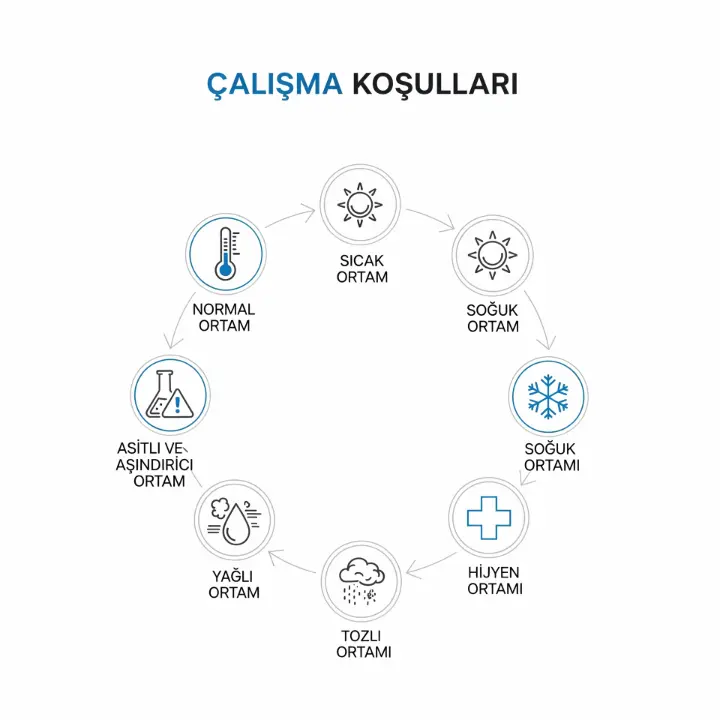
1. Thermal Conditions (Hot and Cold Environments) The temperature range in which mechanical parts operate directly affects the material's dimensional stability and mechanical properties.
Challenges: High temperatures accelerate the thermal aging of polymers (rubber, plastic), causing the material to harden and crack. Low temperatures, on the other hand, cause the material to lose its flexibility and become brittle when it drops below its "glass transition temperature."
Standards and Solutions: When selecting a material, pay attention to the operating temperature range specified in the product's technical data sheet. For high temperatures, materials like Silicone (VMQ) or Fluorocarbon (FKM/Viton®) maintain their stability even at temperatures of +200°C and above, while for cold environments, specially formulated EPDM or Silicone retain their flexibility even at temperatures as low as -50°C.
2. Hygienic and Food Contact Environments In the food, pharmaceutical, and biotechnology industries, every component that comes into contact with the product must comply with strict hygiene and safety protocols
Challenges: Chemical migration from the material to the product, bacterial growth, and inadequate cleanability.
Standards and Solutions: Parts used in these sectors must be certified compliant with FDA 21 CFR 177.2600 (U.S. Food and Drug Administration) and/or (EU) 10/2011 (European Union) regulations. These standards guarantee that the material is safe for food contact and does not leach harmful substances. Typically, food-grade Silicone, EPDM, and special Polyurethane (PU) materials meet these requirements.
3. Abrasive and Dusty Environments In sectors such as mining, agriculture, ceramics, or cement, parts are constantly subjected to the bombardment of abrasive particles.
Challenges: Rapid physical wear on the material surface, dimensional loss, and a dramatic reduction in service life.
Standards and Solutions: One of the most widely accepted standards for measuring a material's abrasion resistance is the DIN 53516 or ISO 4649 test. This test measures how much volume a material loses under a specific amount of friction. A low volume loss indicates high abrasion resistance. Materials like Polyurethane (PU) and natural rubber (NR) generally show superior performance in these tests.
4. Oily, Humid, and Chemical Environments In almost every industrial setting, components are exposed to some form of oil, grease, hydraulic fluid, cleaning chemicals, or water.
Challenges: Chemicals and oils can break down the molecular structure of polymers, causing them to swell, soften, melt, or harden and disintegrate.
Standards and Solutions: The ISO 1817 standard is used to evaluate a material's resistance to liquids. This standard tests the change in volume, weight, and hardness of a material after being immersed in a specific liquid. For petroleum-based oils and fuels, Nitrile (NBR) is the most common and economical solution. For more aggressive chemicals, acids, and bases, materials like EPDM and Fluorocarbon (FKM/Viton®) offer superior resistance.
Conclusion: Selecting the right industrial component is about more than just size and shape. Considering all the challenges of the part's operating environment and choosing the right material compliant with international standards will directly impact your production efficiency and profitability in the long run. At 6genpack, we transparently share the technical specifications and international standards compliance of every product we offer, helping you make the most accurate and durable investment for your business.